13 Things That Actually Determine Whether Airline Pilot Training Works – And Why Most Candidates Get Them Wrong
The gap between wanting to fly and actually sitting in the right seat isn’t talent. It’s architecture. Most people researching airline pilot training spend weeks comparing aircraft types and price tags while missing the structural decisions that determine whether they get hired – or don’t.
Airline pilot training works when the program is built around airline hiring requirements, not just regulatory minimums. A complete integrated ATPL course takes approximately 18 months, covers 13 ATPL theory exams, multi-engine instrument flying, and MCC/JOC training. The difference between programs that produce working First Officers and programs that produce licensed-but-unemployed graduates is whether career placement is built into the structure from day one.
Key Takeaways
- Integrated ATPL training takes 18 months. Programs promising shorter timelines are cutting something real.
- There are 13 ATPL theory exams.
• A type rating is not required to get hired as a First Officer – most airlines train you on type after conditional offer or they’ll inform you where to train. - All-inclusive pricing that covers accommodation removes a major hidden cost variable that catches candidates off guard mid-program.
- Job placement is a structural feature, not a bonus – programs without airline partnerships produce graduates who start the job search from zero.
Why Do So Many Candidates Choose the Wrong Program?
The honest answer: because most of the information available about pilot training is either vague, commercially motivated, or wrong in small ways that compound badly.
Consider a common scenario: a candidate in their mid-twenties, career-changing from finance, spends three months researching programs. They compare hourly rates, aircraft fleets, and location. They don’t ask how many of last year’s graduates are actually flying commercially. They don’t ask whether the school has direct airline partnerships or just a careers page with logos on it. They sign up based on price and brochure quality.
That’s not a failure of intelligence. It’s a failure of the framework.
The right question isn’t “which program is cheapest?” – it’s “which program is structurally designed to get me hired?”
What Does an Integrated ATPL Course Actually Include?
The Airline Transport Pilot Licence (ATPL) integrated course is the structured pathway from zero hours to a frozen ATPL – the minimum qualification for First Officer positions at commercial airlines.
Here’s what a properly structured 18-month program actually contains:
- Ground school and 13 ATPL theory exams – covering subjects including Air Law, Meteorology, Navigation, Aircraft General Knowledge, and Human Performance. Thirteen exams. This is a fixed regulatory requirement under EASA, and it’s a meaningful workload.
- Single-engine VFR flying – building foundational hours and handling skills in a training aircraft.
- Instrument Rating training – this is where the real airline-relevant flying begins. Flying on instruments, in simulated IMC, under ATC control.
- Multi-engine training – transitioning to twin-engine aircraft, which is what commercial operations actually use.
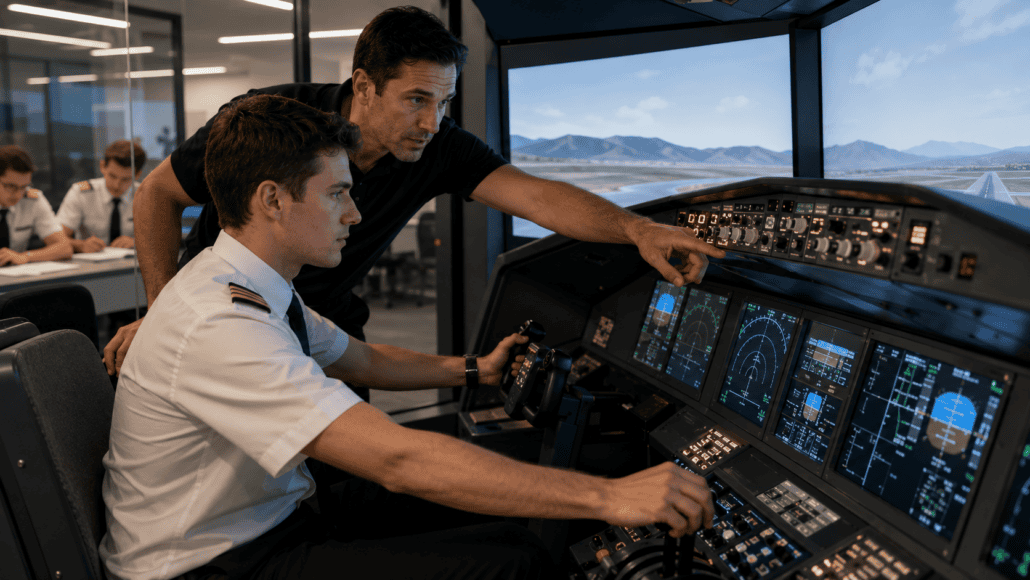
- Airline Pilot Standard Multi-Crew Cooperation (APS MCC) – this is the module most schools underemphasize. APS MCC teaches you to function as part of a two-pilot crew. The JOC introduces jet aircraft handling. Both are required before a commercial airline will seriously consider you
6. Minimum 200 flight hours – the regulatory threshold for a CPL/IR, and the baseline airlines expect before interview.
The theory phase doesn’t end at month four. Ground school and simulator study run in parallel with flying throughout the program. Candidates who treat theory as a front-loaded sprint and then stop engaging with it tend to struggle in airline interviews, where technical knowledge is tested directly.
Why Does the 18-Month Timeline Actually Matter?
Programs that promise 16 months are compressing something. Either the theory preparation is rushed, the flying hours are at bare minimum, or the APS MCC/JOC is abbreviated. None of those outcomes help you at an airline assessment.
A license without a placement pipeline is a credential, not a career.
The 18-month timeline, done properly, gives you enough time to actually absorb 13 subjects at exam standard, build genuine flying competence, and go through MCC without treating it as a box-ticking exercise. Airlines can tell the difference in the sim assessment.
AELO Swiss Academy runs its integrated program at 18 months and some students may take up to 24 months if required. That’s not a limitation – it’s an honest reflection of what the training actually takes.
The Placement Pipeline Problem: What Most Schools Don’t Tell You
Here’s the contrarian claim worth sitting with: the quality of your flying training matters less to your first airline job than the quality of your school’s airline relationships.
That’s not an argument for cutting corners on training. It’s a structural observation about how airline hiring actually works. Airlines with cadet programs and direct academy partnerships are hiring from a pre-screened pool. They’ve already assessed the school’s training standards. The candidate walks into an interview with institutional credibility behind them.
A graduate from a school with no airline partnerships walks into the same interview with only their logbook.
If you’re evaluating programs, ask for documentation on placement outcomes. Ask specifically which airlines have taken graduates in the last 12 months, and how many. Vague claims about graduate success aren’t the same as a verifiable placement record.
If you want to understand how the full program is structured before committing, exploring the academy’s approach directly is worth the time.
The Hidden Cost Variable: Why All-Inclusive Pricing Changes the Calculation
Most program prices quoted in aviation training are not all-inclusive. They cover tuition and flight hours. They don’t cover accommodation, living costs, examination fees, or equipment.
For an 18-month program, that gap can be substantial. A candidate who budgets based on the headline price and then discovers they need to separately arrange and fund accommodation in a country they don’t live in is facing a financial disruption mid-program. That disruption affects training quality.
AELO Swiss Academy’s all-inclusive pricing at €104,950 covers accommodation whether the student takes 18 or 24 months. That’s not a marketing point – it’s a planning tool. You know the number going in. You can structure your financing around a real figure rather than a floor estimate.
Getting the program structure wrong doesn’t just cost time – it costs you the hiring window entirely.
The Type Rating Misconception That Wastes Candidates’ Time
A type rating is a qualification to fly a specific aircraft type – an Airbus A320, a Boeing 737, and so on. It’s expensive, typically €20,000 – €30,000 on top of ATPL training costs.
Here’s what many candidates don’t realize: most major European airlines don’t require you to self-fund a type rating before they hire you. They issue a conditional offer, then put you through their own type rating training as part of the cadet or direct-entry process.
Spending money on a self-funded type rating before you have an airline offer is usually not a strategic investment – it’s anxiety spending. The assumption that you need a type rating to be competitive is often pushed by schools that sell type ratings. It’s worth being clear-eyed about that incentive structure.
What airlines actually want at the selection stage: your frozen ATPL, your hours, your MCC/JOC completion, and your performance in their assessment process. The type rating comes after they’ve decided they want you.
What the ATPL Training Decision Matrix Actually Looks Like
The Pilot Program Fit Matrix is a decision tool for evaluating whether a specific ATPL program is structurally positioned to deliver a commercial flying career – not just a licence.
Use it when comparing programs. Skip it if you’re only comparing aircraft types or locations.
| Decision Factor | What to Look For | Red Flag |
| Program duration | 18 months (full EASA integrated) | Under 16 months – something is compressed |
| Pricing structure | All-inclusive with accommodation | Headline price excluding living costs |
| MCC/JOC inclusion | Full 40 hour APS MCC | Basic 20 hour MCC |
| Type rating pressure | Not required pre-hire at most airlines | School pushing self-funded type rating early |
AELO Swiss Academy holds ATO approval CH.ATO.0311 and is a Diamond Authorized Flight Training Center. Students complete their training under the European Union Aviation Safety Agency (EASA) regulatory framework, with qualifications recognized by airlines across Europe.
Who Is This Training Path Not Right For?
Straight talk: integrated ATPL training at this level isn’t right for everyone, and saying otherwise would be dishonest.
If you’re looking for recreational flying or a private pilot licence, an integrated commercial program is significant overkill in cost and time commitment. If you’re not in a position to commit 18 months to full-time training – financially and logistically – a modular approach done part-time may be more realistic, though it typically takes longer and produces a weaker hiring position without the same placement infrastructure.
The integrated path is designed for candidates who are ready to commit fully, have the financial means to fund the program properly, and are targeting a First Officer position at a commercial airline as the specific outcome. That’s a defined profile. If it’s yours, the integrated route is the right architecture. If it’s not, no amount of enthusiasm changes the fit.
If you’re at the stage of seriously comparing programs and want to understand exactly how AELO Swiss Academy structures the 18-month pathway – including what the airline partnership process actually looks like – the academy’s program overview is the right place to start.
FAQ
How long does integrated ATPL training actually take?
An integrated ATPL program takes 18 months when done properly under EASA standards. Programs advertising shorter timelines are compressing either the theory preparation, the flight hours, or the APS MCC/JOC training – all of which affect your readiness for airline assessments. Budget for 18 months and plan accordingly.
How many ATPL theory exams are there?
There are 13 ATPL theory exams under EASA regulations. Every integrated ATPL program follows this requirement as part of the EASA syllabus.
Do I need a type rating before applying to airlines?
No. Most major European airlines don’t require a self-funded type rating before making a conditional offer. They conduct their own type rating training as part of the cadet or direct-entry process. Spending €20,000 – €30,000 on a type rating before you have an offer is usually not necessary and is sometimes actively discouraged by airlines who prefer to train on their own fleet variant.
What does all-inclusive pricing actually cover?
At AELO Swiss Academy, the all-inclusive price of €104,950 covers the training program and accommodation. This matters because many programs quote a headline figure that excludes living costs, examination fees, and equipment – creating a significant gap between the advertised price and the real cost of completing the program.
What airlines do AELO Swiss Academy graduates fly for?
AELO Swiss Academy has direct program partnerships with SkyAlps, NEOS, Swiss Airlines, and Air France. Beyond these structured pathways, graduates have gone on to fly for a wide range of commercial airlines across Europe and internationally. The direct partnerships are what distinguish a defined hiring pipeline from a general careers page.
Is Switzerland a good location for pilot training?
Switzerland offers consistent airspace access, well-structured ATC environments, and proximity to major European aviation hubs. For candidates targeting European airline careers, training under Swiss and EASA regulatory frameworks means your qualifications are directly recognized by the airlines you’re applying to. AELO Swiss Academy has operated from Switzerland since 1985.
What’s the difference between an integrated and modular ATPL?
An integrated ATPL is a full-time, structured 18-month program that takes you from zero hours to frozen ATPL in a single continuous pathway – with ground school, flying, and APS MCC/JOC sequenced and supervised. A modular ATPL lets you complete the same components separately, often part-time, over a longer period. Integrated programs typically produce stronger airline candidates because the training is cohesive and the school’s placement infrastructure applies to the full cohort. Modular routes suit candidates who can’t commit to full-time training, but they require more self-management and usually don’t come with the same airline partnership access.
The candidates who get hired aren’t necessarily the most naturally gifted pilots. They’re the ones who chose a program with the right architecture, prepared for 13 exams instead of treating theory as a formality, and walked into airline assessments with institutional backing behind them.
That’s a repeatable outcome. It just requires choosing the right structure from the start.
About the Author
AELO Swiss Academy is a Swiss-based aviation training academy established in 1985, specializing in integrated ATPL programs that take candidates from zero flying experience through to the qualifications required for commercial airline First Officer careers. Holding ATO approval CH.ATO.0311 and Diamond Authorized Flight Training Center status, the academy works with aspiring commercial pilots, career-changers, and international students preparing for airline careers across Europe and beyond.