
AELO Swiss Academy: Setting a New Standard in European Airline Pilot Training
How partnerships with SWISS, Air France, SkyAlps, EPST and AMRIS Aviation are establishing AELO as one of Europe’s leading airline-focused flight training academies.
In an aviation industry facing sustained demand for highly qualified pilots, the challenge for airline pilot training organisations extends far beyond teaching students how to fly. Airlines increasingly expect newly qualified pilots to demonstrate the technical competence, operational discipline, decision-making abilities and professional attitudes required to transition successfully into a commercial airline cockpit.
For AELO Swiss Academy, headquartered at Locarno Airport in Switzerland, this philosophy has become the foundation of its training model.
With more than four decades of aviation training heritage, AELO has undergone a remarkable transformation in recent years. What began as a regional Swiss flying school has evolved into an international pilot training organisation operating across three European bases, equipped with a modern and expanding fleet, advanced simulator infrastructure and an increasingly sophisticated operational management structure.

Yet perhaps the most compelling evidence of this transformation is not the growth of its aircraft fleet or training facilities. It is the confidence placed in AELO by some of Europe’s most respected airlines and aviation training organisations.
Today, AELO’s partnerships encompass SWISS International Air Lines, France’s École Nationale de l’Aviation Civile (ENAC) — through which AELO trains Air France cadets — SkyAlps Airlines, and the Netherlands-based European Pilot Selection & Training (EPST), whose graduates progress to airlines including KLM and Transavia.
Its collaboration with AMRIS Aviation, through the AMRIS Mentored Programme, further strengthens the academy’s commitment to preparing students for the realities of airline employment.
Together, these relationships illustrate a central principle behind AELO’s success: the ultimate measure of a flight school’s quality is not simply the number of licences it issues, but the standard of pilots it produces and the confidence those pilots inspire in the airlines that employ them.
Training pilots to airline standards from their very first flight
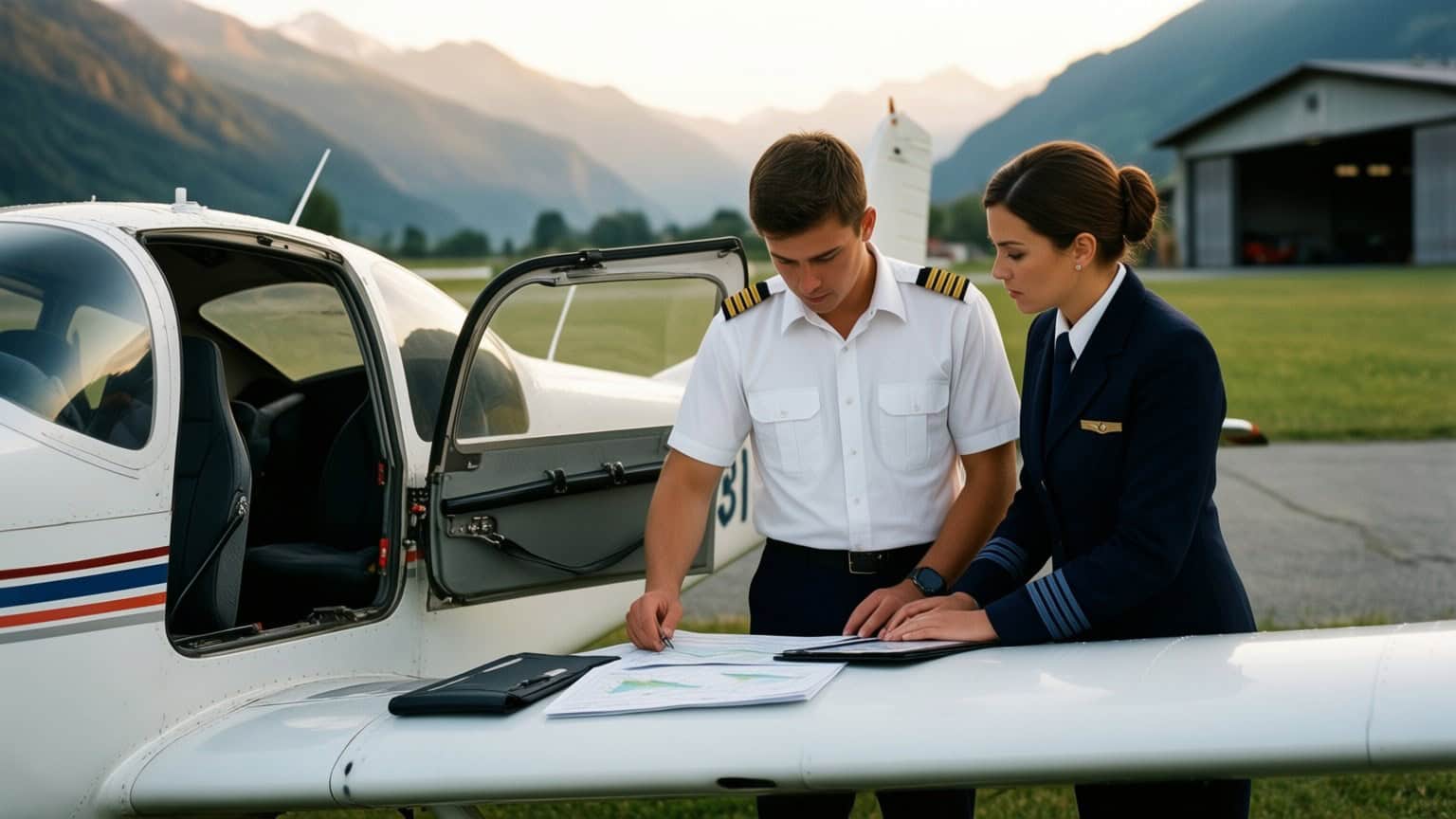
AELO’s educational philosophy is built around an important distinction: obtaining a commercial pilot licence and becoming an airline-ready professional are not necessarily the same thing.
While regulatory requirements establish the competencies necessary to obtain a licence, airlines operate within an environment where standardisation, procedural discipline, crew coordination, threat and error management, and sound decision-making are essential.
AELO has progressively integrated these principles into its training methodology, drawing on the operational experience of airline pilots who form an important part of its instructional and management teams.
Rather than introducing professional airline behaviours only during the final stages of training, AELO seeks to develop them from the earliest flying lessons. Students are encouraged to approach flight preparation, briefing, checklist execution, communication, risk assessment and post-flight debriefing with the discipline expected in commercial aviation.
The academy’s training methodology incorporates concepts derived from Evidence-Based Training and competency-based evaluation, with particular attention to the development of both technical and non-technical skills.
This approach also allows AELO to adapt its Standard Operating Procedures (SOPs) and instructional methods to the specific requirements of airline customers. For an airline commissioning cadet training, this means that the flight school can begin introducing elements of the operator’s procedures and safety culture well before the cadet enters type-rating training.
AELO’s philosophy is therefore not simply to produce pilots capable of passing examinations. It is to develop professionals who are better prepared for the transition into multi-crew airline operations.
This commitment to airline-oriented training has become a defining characteristic of the academy and a major factor behind its expanding portfolio of institutional partnerships.
SkyAlps: A direct pathway from flight training to airline employment
Among AELO’s most distinctive training opportunities is its Multi-Crew Pilot Licence (MPL) programme developed in partnership with SkyAlps Airlines.
Unlike a conventional ATPL Integrated course, the MPL pathway is specifically structured around the requirements of a partner airline, with training designed to prepare cadets for operations in a multi-crew commercial aircraft environment.
The AELO–SkyAlps programme is tailored to the airline’s De Havilland Canada Dash 8 (DHC-8) operations and provides selected cadets with a structured route from initial pilot training towards employment with the airline.
A particularly important feature of this programme is its conditional job guarantee, offering candidates a defined employment pathway with SkyAlps, subject to successful completion of the programme and the applicable contractual, licensing and operational requirements.
This represents a significant advantage for aspiring pilots. One of the greatest uncertainties facing students who invest in professional flight training is the transition between obtaining their qualifications and securing their first airline position.
The SkyAlps MPL programme is designed to reduce that uncertainty by connecting the training process directly to a participating airline’s recruitment and operational needs.
The programme also reflects a deeper level of cooperation between AELO and its airline partner. MPL training requires alignment between the approved training organisation and the operator, including defined competency standards, operational procedures and the progressive development of multi-crew capabilities.
For AELO, the ability to deliver such a programme demonstrates its capacity to move beyond conventional flight instruction and operate as a training partner within an airline’s pilot development pipeline.
For students, it provides something equally valuable: the opportunity to begin their aviation careers with a clearly identified airline destination.
EPST: Dutch confidence in Swiss training excellence
Another significant endorsement of AELO’s training standards comes from its partnership with EPST.
EPST is an established organisation specialising in the selection, preparation and training of aspiring airline pilots. Its graduates have progressed to prominent Dutch airlines, including KLM Royal Dutch Airlines and Transavia.
For an organisation whose reputation depends on the quality of its candidates and their subsequent success in airline recruitment, selecting a flight training partner is an important decision.
AELO has established itself as a principal training partner for EPST, with approximately 70 EPST students allocated to AELO for training in 2026.
This is more than a commercial achievement; it represents institutional confidence in AELO’s instructional standards, operational reliability and ability to manage significant volumes of professionally selected cadets.
EPST’s selection process is designed to identify candidates with the aptitude, competencies and personal characteristics required for airline careers. AELO’s responsibility is then to transform that potential into practical flying proficiency and professional readiness.
The relationship creates a complementary training structure: EPST contributes its experience in pilot selection and airline recruitment pathways, while AELO provides the flight training infrastructure, instructors, operational systems and learning environment.
AELO is doing more than training recreational pilots or independent licence holders. It is participating in the development of future airline professionals for one of Europe’s most established commercial aviation markets.
The scale of the 2026 intake also reflects AELO’s growing capacity to deliver training consistently across larger student populations, while maintaining the standardisation and individual oversight that professional pilot development requires.
ENAC and Air France: Training the next generation of French airline pilots
AELO’s international reputation has been further strengthened through its training agreement with ENAC.
ENAC is one of Europe’s most prestigious aviation education institutions, with a long history of preparing pilots and aviation professionals for the French aviation sector.
Under the agreement, AELO provides flight training for Air France cadets at its Cuneo training base in northern Italy.
The programme marks an important milestone in AELO’s development. Training cadets destined for Air France requires an organisation capable of delivering consistent instruction, maintaining rigorous safety and quality standards, and coordinating training according to demanding institutional requirements.
The planned programme comprises 24 cadets in 2026, organised into two groups of 12, with a further 36 cadets planned for 2027 across three groups of 12.
This structured progression reflects the capacity of AELO’s Cuneo operation to support recurring airline cadet programmes rather than isolated training assignments.
Cuneo Airport provides an attractive environment for professional flight training. Its controlled operating conditions, instrument flight procedures and available infrastructure make it particularly suitable for structured training programmes that require predictable aircraft utilisation and efficient scheduling.
The airport also supplements AELO’s Swiss operations by providing additional capacity and greater flexibility in the allocation of aircraft, instructors and training activities.
For the academy, the ENAC agreement demonstrates that its training model can be successfully extended beyond its Swiss headquarters while preserving common standards across different operating locations.
For Air France cadets, the partnership combines Swiss organisational oversight with the operational advantages of an Italian training base.
Importantly, the programme illustrates the increasingly international nature of professional pilot education. A French aviation institution can entrust the practical development of future Air France pilots to a Swiss training organisation operating in Italy, provided that the training standards, regulatory framework and operational capabilities meet its requirements.
That is precisely the type of cross-border aviation training partnership AELO has positioned itself to deliver.
SWISS International Air Lines: A partnership built on quality and standardisation
AELO’s relationship with SWISS International Air Lines is particularly significant given the airline’s reputation for operational precision, professionalism and safety.
Under its cooperation agreement, AELO is recognised as a SWISS partner flight school and provides pilot training for students enrolled in the Bachelor of Science in Aviation programme at Zurich University of Applied Sciences (ZHAW).
This pathway combines university-level academic education with the practical and theoretical flight training required for a professional aviation career.
The programme is carefully structured around the students’ university commitments. Initial practical training, including the Private Pilot Licence (PPL) phase, is scheduled during university summer breaks, while subsequent training phases are coordinated with the academic calendar and continue after completion of the degree.
The cooperation extends far beyond the provision of aircraft and instructors.
AELO and SWISS coordinate training schedules, monitor student progress, define grading and reporting requirements, and maintain oversight of instructional quality.
One further key element is the alignment of training procedures with the airline’s operational philosophy. AELO’s agreement provides for periodic adjustments to the SOPs used in SWISS courses, incorporating relevant input from the airline into the academy’s procedures.
The agreement also establishes dedicated instructional oversight, including standardisation requirements for instructors assigned to SWISS trainees and the appointment of personnel responsible for the programme.
In addition, the two organisations have made provision for reviewing graduate performance after their transition into airline operations, allowing the training process to benefit from feedback beyond the flight school itself.
This is a valuable distinction. The objective is not simply to deliver a prescribed syllabus, but to establish a continuous relationship between initial pilot education and the standards expected by the airline.
For AELO, being entrusted with the training of SWISS-associated university cadets is an important recognition of its ability to deliver a disciplined, structured and airline-oriented training experience.
It also demonstrates the flexibility of its educational model, which can accommodate both full-time integrated cadets and university students following a more complex academic and practical training schedule.
AMRIS Aviation: Bringing personalised mentoring and airline readiness into pilot training
While airline partnerships validate the technical and operational quality of AELO’s training, the academy also recognises that successful pilot development requires more than flight instruction alone.
The transition from aspiring pilot to airline First Officer can be demanding, both academically and personally. Students must manage intensive theoretical studies, practical flight training, assessments, financial commitments and the uncertainty associated with entering a competitive profession.
To address these challenges, AELO has partnered with AMRIS Aviation, formerly associated with The Airline Pilot Club (APC), to offer the AMRIS Mentored Programme as a premium enhancement to its professional pilot training pathways.
The programme draws on the experience of Andy O’Shea, former Head of Training at Ryanair, whose expertise in airline training, pilot assessment and professional development contributes to its airline-focused approach.
The concept is straightforward: AELO provides the technical training, aircraft, instructors, simulators and licensing framework, while AMRIS adds a complementary layer of personal mentoring, competency development and airline career preparation.
The programme is designed to support students throughout their training journey, from initial preparation to the transition towards airline employment.
One of its distinguishing features is the integration of individual mentoring with structured competency assessment.
Through tools such as Symbiotics psychometric assessments, competency-based interviews and personalised training baseline reports, the programme seeks to identify individual strengths and development areas at an early stage.
AMRIS’ AI-supported development platform, Amelia, is designed to provide additional performance insight, using training-related information to support more personalised development and targeted learning.
Rather than relying exclusively on examination results or the completion of individual flight exercises, this approach aims to provide students with a broader understanding of their progression towards the competencies expected of an airline pilot.
Human mentoring remains central to the programme. Students receive guidance from aviation professionals who understand the challenges of flight training and the expectations of airline recruitment departments.
Another important component is the involvement of Resilient Pilot, whose coaching activities focus on subjects such as Crew Resource Management (CRM), Threat and Error Management (TEM), professional competencies and resilience.
These are particularly relevant skills for airline operations, where effective teamwork, communication, workload management and sound judgement are as important as technical aircraft handling.
The programme also includes scenario-based training designed to prepare students for the Airline Pilot Standard Multi-Crew Cooperation (APS MCC) phase, as well as structured airline assessment and interview preparation.
For graduates who meet the applicable standards, AMRIS offers access to its Airline Ready Pilot Pool, a platform intended to improve visibility and connectivity with potential airline recruitment opportunities. Participation in this pool does not itself constitute a guarantee of employment.
The collaboration therefore represents an important extension of AELO’s educational philosophy.
It acknowledges that a student may be technically capable yet still benefit from guidance in areas such as confidence, resilience, self-awareness, teamwork and interview performance.
By combining professional flight instruction with mentoring, performance insight and airline recruitment preparation, AELO aims to provide a more complete pathway from initial enrolment to the first airline cockpit.
In an industry where the ability to obtain a licence does not automatically guarantee success in airline selection, this broader approach to pilot development is an increasingly important differentiator.
Three strategic training bases: Locarno, Lugano and Cuneo
Locarno, Switzerland — Headquarters
The centre of AELO’s operations, housing its modern headquarters, classrooms, briefing facilities, simulators, administration and core training activities. Locarno provides an environment combining Swiss aviation standards with varied flying conditions in the southern Alps.
Lugano, Switzerland — Instrument training environment
Lugano complements Locarno with additional operational capacity and access to instrument approach procedures. Its terrain and airspace provide valuable opportunities to develop precision, situational awareness and disciplined flight planning.
Cuneo, Italy — International cadet training hub
Cuneo has become strategically important for dedicated airline training programmes, including the ENAC–Air France partnership. Its runway infrastructure, instrument procedures and available operational capacity support larger training cohorts and sustained aircraft utilisation.
The development of this multi-base operating model has been essential to AELO’s growth.
As student numbers increase, a flight training organisation must balance the availability of aircraft, instructors, airspace, simulator sessions and airport infrastructure. Expanding within a single location can eventually create operational bottlenecks, particularly when multiple courses are competing for the same resources.
By distributing training activities across Locarno, Lugano and Cuneo, AELO has created a more flexible operating structure capable of supporting different training phases and dedicated institutional programmes.
Each location contributes distinct operational advantages while remaining part of a coordinated training organisation.
Students also benefit from exposure to different airport environments, terrain, airspace structures and operational procedures. This variety is valuable in developing adaptable pilots capable of operating confidently beyond a familiar home airfield.
The multi-base structure is therefore more than a capacity expansion strategy. It is an important component of AELO’s commitment to producing versatile, operationally capable pilots.
Exceptional growth supported by investment in aircraft, infrastructure and people
AELO’s expansion is particularly evident in its operational figures.
The academy’s May 2026 institutional training proposal reported 304 students under training, approximately 92% of whom were enrolled in integrated ATPL programmes.
The school has also continued to invest in its training fleet, adding aircraft to increase capacity and support the growing demand from both independent students and airline partners.
During the first eight months of 2026, AELO expanded its fleet through the addition of ten aircraft, including Tecnam P2008, Diamond DA20, Diamond DA40 and Diamond DA42 models.
This investment forms part of a broader fleet development strategy, including an order for 18 Diamond DA20 aircraft, with deliveries scheduled across 2026 and 2027.
The Diamond DA20 and DA40 provide modern single-engine training platforms, while the twin-engine DA42 supports advanced multi-engine and instrument training. The academy’s simulator infrastructure further supports aircraft-based instruction, allowing students to develop procedural knowledge, instrument proficiency and multi-crew competencies in controlled training environments.
The impact of these investments is reflected in AELO’s rapidly increasing training activity.
Source: AELO operational reporting and August 2026 FlightLogger data. Figures are rounded and may reflect different reporting definitions for aircraft and combined training activity.
Between January and July 2026, AELO recorded 8,421 commercial aircraft flight hours, representing an increase of around 50% compared with the equivalent period in 2025.
August 2026 was especially noteworthy, with approximately 1,810 aircraft flight hours compared with 791 in August 2025 — an increase of approximately 129%.
These results demonstrate the extent to which AELO has expanded its operational capabilities within a relatively short period.
However, the most important achievement is not the additional hours themselves. It is developing the organisational systems required to sustain higher activity levels while preserving training quality and safety.
Scaling without compromising standards: The operational transformation behind AELO’s success
Rapid growth in professional flight training presents significant management challenges.
Increasing the number of aircraft and students is comparatively straightforward. Ensuring that every aircraft is maintained correctly, every instructor follows consistent procedures, every student receives appropriate supervision and every training event is properly planned is considerably more complex.
AELO’s expansion has therefore been accompanied by a progressive strengthening of its organisational structure.
Central to this transformation is the development of a more systematic approach to standardisation, safety management, quality assurance and operational planning.
Standard Operating Procedures and Instructor Standardisation
AELO places considerable emphasis on the consistent application of SOPs across its training operations.
Standardised procedures establish a common framework for flight preparation, aircraft operation, abnormal situations, instructor interventions and performance assessment.
For a growing academy employing multiple instructors across different bases, this consistency is essential. It reduces unnecessary variations in instructional technique and helps ensure that students receive a coherent training experience throughout their course.
The importance of standardisation becomes even greater when training is delivered on behalf of airlines.
The SWISS cooperation agreement, for example, specifically addresses instructor standardisation, training supervision and the adaptation of procedures to incorporate relevant airline requirements.
AELO’s ability to customise training methods while maintaining common internal standards is an important advantage when serving multiple airline customers with different operational philosophies.
Safety Management and Regulatory Oversight
AELO operates as a Swiss Federal Office of Civil Aviation (FOCA) Approved Training Organisation under approval CH.ATO.0311.
Its Safety Management System (SMS) is subject to regulatory oversight and periodic auditing, supported by documented risk assessment, occurrence reporting, compliance monitoring and management-of-change processes.
These systems are especially important during expansion, when new aircraft, instructors, facilities or operating locations introduce additional organisational complexity.
The opening and integration of the Cuneo training base, for example, required structured management-of-change procedures to evaluate and manage the operational implications of extending training activity to another airport.
AELO’s quality assurance arrangements also benefit from experienced aviation professionals, including personnel with airline operational backgrounds and regulatory inspection experience.
A particularly encouraging assessment was recorded in the academy’s May 2026 institutional proposal, which reported that a FOCA inspector had observed a very high standard of instruction across theoretical knowledge, simulator and flight training, without identifying significant issues.
Such regulatory feedback provides an important independent perspective on the academy’s instructional quality.
Professional Planning and Resource Management
One of the most significant operational developments has been the strengthening of AELO’s planning function.
Professional flight training requires the coordination of numerous interdependent resources: aircraft availability, instructor schedules, maintenance requirements, weather conditions, airport operating restrictions, simulator sessions and the progression of individual students through their training syllabi.
When an academy is responsible for several hundred students, including cadets enrolled in airline-specific programmes, effective planning becomes a critical determinant of training continuity.
AELO has been developing a more structured, data-driven planning system, including the implementation of the Aeroplanned platform.
The objective is to integrate student cohorts, aircraft availability, instructor resources and syllabus progression into a coordinated long-term operational plan.
This approach allows management to anticipate potential capacity constraints, evaluate different operating scenarios and make better-informed decisions about resource allocation.
It also supports greater predictability in the delivery of training programmes, an important requirement for airlines that need cadets to progress according to defined recruitment and operational schedules.
While aviation training will always be affected by external factors such as weather, maintenance and airspace restrictions, stronger planning systems help organisations respond to these challenges more effectively.
Integrated Maintenance and Technical Support
AELO’s operational structure also benefits from integrated aviation support capabilities, including Part-CAMO continuing airworthiness management and Part-145 maintenance functions.
These capabilities support closer coordination between flight operations, maintenance planning and aircraft availability.
As fleet utilisation increases, this integration becomes even more valuable. Aircraft reliability, preventive maintenance and efficient technical support are essential for sustaining high training volumes without allowing operational pressures to compromise safety.
The combination of standardised instruction, regulatory oversight, professional planning and technical support is what enables AELO to move from the operating model of a traditional flight school towards that of a larger-scale airline training organisation.
From training success to airline employment
Ultimately, the success of any professional flight academy should be measured not only by the qualifications its students obtain, but also by their ability to progress into aviation careers.
AELO’s established graduate outcomes provide an encouraging indication of its training model’s effectiveness.
The academy has reported that approximately 96% of its graduates secure an airline position or employment opportunity within six months of graduation.
This figure is especially relevant in a sector where aspiring pilots frequently face uncertainty about the availability of their first professional flying position.
The academy’s alumni have progressed to airlines including SWISS, KLM, Transavia, Ryanair, easyJet, Edelweiss, Helvetic Airways, Lufthansa, Etihad Airways and Emirates.
These outcomes reflect the value of combining rigorous professional training with airline relationships, career preparation and a training environment that encourages the development of professional competencies from the beginning.
The growing number of airline-linked programmes also creates a valuable feedback mechanism. Through its relationships with airlines, recruitment organisations and mentoring specialists, AELO can gain greater insight into the competencies, behaviours and preparation that employers expect from newly qualified pilots.
This information can, in turn, help inform the continuous development of its training methodology.
The result is an educational model that increasingly connects the entire journey: from candidate selection and initial flight training through to competency development, airline assessment preparation and eventual employment.
A new chapter for European pilot training
AELO Swiss Academy’s transformation represents a compelling example of how a modern flight training organisation can grow while placing quality, safety and airline relevance at the centre of its strategy.
Its partnerships with SWISS, ENAC/Air France, SkyAlps, EPST and AMRIS Aviation are more than commercial relationships. They reflect the academy’s growing role within the European airline pilot training ecosystem.
Each partnership contributes a different dimension to this development.
SkyAlps demonstrates AELO’s ability to deliver an airline-specific MPL programme with a defined employment pathway.
EPST provides evidence of the confidence placed in AELO by an established Dutch pilot selection and training organisation whose graduates progress to leading Dutch airlines.
ENAC’s decision to entrust AELO with the training of Air France cadets highlights the academy’s ability to deliver structured institutional training across international borders.
The SWISS partnership demonstrates the importance of airline-specific procedures, standardisation and continuous quality oversight.
And AMRIS Aviation extends the academy’s proposition beyond technical flying skills, providing additional mentoring, competency development and preparation for the challenges of airline recruitment.
Behind these partnerships stands an organisation that has invested significantly in its people, aircraft, facilities, operational planning and safety management systems.
With three strategic training bases in Locarno, Lugano and Cuneo, an expanding modern fleet, several hundred students under training and rapidly increasing flight activity, AELO has established the foundations for continued growth.
Yet its most important asset remains the trust of the airlines and aviation institutions that depend on the quality of its training.
As the aviation industry continues to evolve, the demand will not simply be for more pilots, but for pilots who are better prepared, more adaptable and capable of meeting increasingly sophisticated operational standards.
AELO Swiss Academy’s ambition is to meet that challenge: not simply by teaching the next generation of pilots how to fly, but by preparing them to become the airline professionals of tomorrow.